Saturday, March 30, 2019

Trump tariffs costing US consumers $1.4 billion per month, study shows

The Trump administration's trade policies and tariffs reduced U.S. income at a rate of $1.4 billion per month by the end of last November, according to new research from the Federal Reserve Bank of New York, Princeton University and Columbia University.

The collaborative study found that U.S. businesses and consumers saw "substantial increases" in the price of goods throughout last year, including a "complete passthrough" of U.S.-imposed tariffs onto imported items. The economists — the New York Fed's Mary Amiti, Princeton professor Stephen Redding and Columbia professor David Weinstein — also said Americans suffered by a lack of import variety and disruptions to supply chains.

"Economists have long argued that there are real income losses from import protection. Using the evidence to date from the 2018 trade war, we find empirical support for these arguments," the researchers wrote. "Losses mounted steadily over the year, as each wave of tariffs affected additional countries and products, and increased substantially after the imposition of the wave 6 tariffs on $200 billion dollars of Chinese exports."

Amiti, Redding and Weinstein found that while losses were accumulating at a rate of $1.4 billion per month by last November, total losses from January 2018 through November 2018 ballooned to a conservative estimate of $6.9 billion.

That number may be too low, the economists said, because their model assumes that the U.S. government uses tariff tax revenues to offset the welfare burden. If the U.S. government did not offset the cost of the tariffs to the American consumer with the new tax revenues, the full value of the tariff payments would be $12.3 billion.
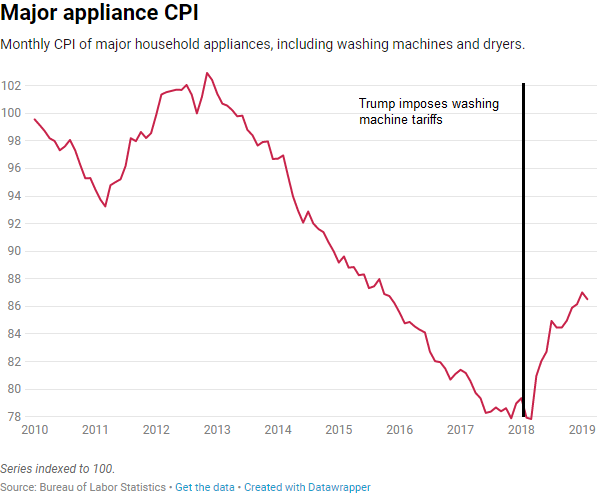
The White House imposed a variety tariffs on goods imported from economic partners of the U.S. in 2018. The tit-for-tat between the U.S. and China has come as Trump and the U.S. Trade Representative try to protect American intellectual property and curb a steep trade deficit.

Trump has had varying success with the tariff tactic, winning both a revised version of the North American Free Trade Agreement as well as alienating key allies including Canada and the European Union. The White House announced a round of tariffs on $200 billion of products imported from China at a 10 percent rate last year.

The White House also announced last year the introduction of a 20 percent tariff on the first 1.2 million imported large residential washing machines from South Korea in the first year and a 50 percent tariff on machines above that number. LG Electronics told retailers less than one week after that decision that it would hike prices thanks to Trump's protective policy.

Less variety

The research team also found that American consumers are also harmed during a trade war in terms of the variety of goods they can purchase. Consumers benefit from open trade and the ability to purchase more unique goods — like French wine and Colombian coffee, for example — that might be foregone if trade barriers are high.

In the three years prior to the imposition of tariffs, all categories of goods experienced increases in the number of varieties offered in the U.S., the researchers said.

"However, the imposition of the tariffs is associated with sharp drops in the number of imported varieties entering the U.S. in all sectors except the wave 1 products (washing machines and solar panels)," they wrote.

"These results suggest that some of the tariffs were prohibitive, reducing imports to zero. This can create a measurement problem that can arise if we try to assess the price impacts of tariffs on goods that are no longer imported."

The trade war also caused "dramatic" turmoil in supply chains, as about $165 billion of trade ($136 billion of imports and $29 of exports) is lost or redirected through company and customer efforts to circumvent tariffs.

"We find that the U.S. tariffs were almost completely passed through into U.S. domestic prices, so that the entire incidence of the tariffs fell on domestic consumers and importers up to now, with no impact so far on the prices received by foreign exporters," the Fed, Princeton and Columbia economists wrote. "We also find that U.S. producers responded to reduced import competition by raising their prices."

Sunday, March 24, 2019

How investors should play the race for Mindtree


The race for owning Mindtree has heated up. Media reports suggest that VG Siddhartha, one of the large non-promoter shareholders who along with his group companies own about 20.4 percent of Mindtree, wants to monetise his investments. The likely buyer is rival IT company L&T Infotech (LTI).

Should the deal go through and it results in a change in control, a mandatory open offer, whereby LTI acquires 51 percent stake, remains a possibility. Media reports also suggest interest from private equity firms, a probable white knight at the behest of the promoters or even a buyback to appease shareholders.

While it is speculative to comment on who will finally end up buying the stake of Siddhartha, the battle for Mindtree is good news for minority shareholders. Mindtree is obviously a highly sought after company which has carved out a niche for itself in new technology areas with its early adoption of digital tech that is beginning to yield rich dividends now. The world has been closely following the success story and many (including rivals) want to be a part of this journey now.

What if the buyer is LTI?

While the contours of the deal are not known, what would be critical would be the approach of the founders -- whether they exit and handover complete control to the LTI management.

related news Finalizing software upgrade, revising pilot training for 737 Max, says Boeing IOC hopes to restart fire-hit CDU at Panipat plant in 2-3 days Subroto Bagchi quits govt job, back at Mindtree to fend off L&T hostile takeover

Mindtree's founders Krishnakumar Natarajan, NS Parthasarathy, Rostow Ravanan and Subroto Bagchi hold 3.72 percent, 1.43 percent, 0.71 percent and 3.1 percent stake, respectively, and were opposed to the idea of ceding control.

At the rumoured price of Rs 981 per share, the value of  Siddhartha's stake amounts to Rs 3,288 crore. However, if there is a change in control and LTI ends up acquiring close to 51 percent of Mindtree, whereby the latter becomes a subsidiary, the cost of this acquisition might rise to Rs 8,205 crore.

As on December 2018, LTI had cash and liquid investments of close to Rs 2,032.8 crore. We do not see any reason why a rival like LTI would like to remain a passive investor in Mindtree. Hence, it is not unreasonable to assume that should this deal goes through, LTI is likely to acquire a controlling stake of 51 percent.

Given the balance sheet strength of LTI (net worth Rs 4387 crore), the exact nature of financing the acquisition (the vehicle through which the stake is acquired, the nature of the leverage) would largely dictate whether the acquisition is value accretive from the start for LTI shareholders. By controlling 51 percent of Mindtree, without assuming any synergistic benefits, LTI will have access to Rs 460 crore of profit in FY20. If the total interest cost that LTI has to bear is less, then the acquisition stands to be value accretive from inception.

Synergy gains

Over the medium to long term, synergistic gains will flow through. First and foremost it helps the business of LTI to scale up. On the basis of nine month FY19 financials, the combined revenue of LTI and Mindtree would be close to $1.7 billion, the sixth largest in the industry.

mindtree1

Source: Company

Their geographical presence is similar with 73.4 percent of revenue accruing from the US and 18.7 percent from Europe for Mindtree, not very different from LTI's which earns close to 67 percent from the US and 17 percent from Europe.

In terms of verticals, however, LTI has a lot to gain as Mindtree has a strong presence in technology, media and services (close to 40 percent) where the rate of growth of digital adoption is very high. The other verticals where Mindtree has a strong footprint are retail and consumer packaged goods (CPG) and travel and hospitality – industries that are at the forefront of digital adoption. In fact, the share of digital in total business for Mindtree is much higher at 49.5 percent compared to 37 percent for LTI.

mindtree2

Source: Company

Incidentally, Mindtree's revenue per employee (thanks to the higher value added in digital) is a tad higher than LTI.

However, LTI has been reporting a much better operating margin of close to 20 percent compared to 15 percent for Mindtree. While for LTI this has come with a record high utilisation rate of 82 percent (compared to 74.6 percent for Mindtree), we feel the synergistic benefits, coupled with the sharper focus of LTI management, can lead to improvement in Mindtree's margin performance.

The client concentration matrix of both the companies is similar with close to 33 percent of revenue accruing from the top five clients.

mindtree3

Source: Company

In the past three months, LTI has underperformed while Mindtree has outperformed, riding on better result and rumours of this stake transfer.

mindtree4

Source: Moneycontrol Research

Unless the contours of the transaction makes it value accretive for LTI shareholders, we expect LTI's underperformance to continue in the near term. Investors keen on participating in this theme should do it through Mindtree.

We are not very upbeat about the probability of buyback thwarting a hostile takeover as the quantum of such buyback would be very limited.

Disclaimer: Moneycontrol Research analysts do not hold positions in the companies discussed here First Published on Mar 18, 2019 09:35 am